

Recycled materials reduce the upstream resource cost of clothing, but their full environmental benefit only lands when paired with durable design, longer garment use, and clean manufacturing. Certifications like the Global Recycled Standard (GRS) and OEKO-TEX give you a starting point for verification, and life-cycle assessments (LCAs) consistently show recycled polyester staple fiber uses substantially less energy than virgin polyester in production. The practical upshot: choose recycled-content pieces built to last, wear them longer, and care for them well.
Table of Contents
- How recycled materials reduce the environmental cost of clothing
- What recycled materials go into clothing and how they’re made
- When recycled materials don’t help: common caveats and life-cycle trade-offs
- What consumers can do to make recycled clothing really count
- Why recycled materials alone can’t solve fashion’s impact
- Final verdict: are recycled materials worth it for consumers?
- Key Takeaways
- The case for buying less and wearing more
- Kyndeoactivewear’s take on durable, recycled-content activewear
- Useful sources and further reading
- FAQ
How recycled materials reduce the environmental cost of clothing
The gains are real and measurable. RPSF production uses substantially less energy than virgin polyester, which directly lowers greenhouse gas emissions at the fiber stage. Diverting post-consumer PET bottles into apparel also keeps plastic out of landfills and reduces demand for petroleum-derived virgin feedstock.
| Material | Key benefit vs. virgin | Primary source |
|---|---|---|
| Recycled polyester (rPET) | ~30–50% lower energy use | RPSF industry analyses |
| Recycled nylon | Reduced oil extraction, lower GHG | LCA literature |
| Recycled cotton | Water savings, landfill diversion | Textile LCA reviews |
The system-level picture matters too. Every ton of PET bottles converted to fiber is a ton not incinerated or buried. For circular supply chains, that also translates to lower raw-material costs over time. One press summary of academic research found that clothing reuse can deliver dramatically lower environmental impact than new production in certain measures, which puts recycled-material gains in perspective: recycling helps, but keeping garments in use longer helps even more.
What recycled materials go into clothing and how they’re made
Three feedstocks dominate the market today.
- Recycled cotton: — Derived from pre-consumer cutting waste (factory scraps) or post-consumer garments. Mechanical recycling shreds fabric into fiber; chemical routes dissolve and re-spin it for higher quality output.
Mechanical vs. chemical recycling is a distinction worth knowing. Mechanical recycling is lower-cost and widely available, but it shortens fiber length and can reduce tensile strength over cycles. Chemical recycling dissolves the polymer or cellulose back to a near-virgin state, preserving quality, though it requires more energy and is still scaling up. Advances like pyrolysis and chemical dissolution are expanding options, but contamination, sorting complexity, and cost remain barriers at scale.
Pro Tip: When reading a label, “post-consumer recycled” (PCR) means the material came from a product a consumer actually used and discarded. “Pre-consumer” or “post-industrial” means factory offcuts that never reached a buyer. Both reduce waste, but PCR content addresses a harder-to-solve waste stream.
When recycled materials don’t help: common caveats and life-cycle trade-offs
Recycled content is not a blanket fix. Several scenarios reduce or eliminate its benefit.
| Scenario | Why the benefit shrinks |
|---|---|
| Fossil-powered recycling facility | Energy savings disappear if electricity comes from coal or gas |
| Downcycling to lower-grade use | Quality loss means the material can’t replace virgin fiber again |
| Short garment lifespan | Per-use impact stays high regardless of feedstock |
| High contamination in feedstock | Increases processing energy and lowers output quality |
An LCA of a garment made from chemically recycled cotton found that cradle-to-gate manufacturing is the dominant hotspot, not the fiber sourcing stage. That means the factory’s energy mix and production practices matter as much as the recycled label on the hangtag. A case study published in Sustainability found that garments produced in green-certified (LEED) facilities scored measurably higher on environmental performance than identical products made in conventional factories.
Systematic reviews of textile reuse and recycling find that reuse is often more beneficial than recycling when comparing like-for-like scenarios. Recycling beats landfill and incineration in nearly all reviewed studies, but the margin over reuse is rarely in recycling’s favor. Source: Chalmers University systematic review
Methodological choices in LCAs also shift outcomes. The cut-off method and the circular footprint formula can produce different results from the same data, so treat single-number marketing claims with appropriate skepticism.
What consumers can do to make recycled clothing really count
The fiber is only the starting point. How you use and care for a garment determines most of its real-world impact.
- Prioritize durability first. Buy pieces designed for multiple contexts, like gym-to-street styles that move from a workout to errands without a wardrobe change. Fewer, better pieces beat a closet full of single-use items.
- Wear it longer. Each additional use cycle lowers the per-use carbon cost. An activewear wardrobe built around versatile essentials naturally extends garment life.
Pro Tip: Air-dry activewear whenever possible. Dryer heat breaks down elastic fibers faster than almost any other care factor, shortening the lifespan of leggings and fitted sets significantly.
Why recycled materials alone can’t solve fashion’s impact
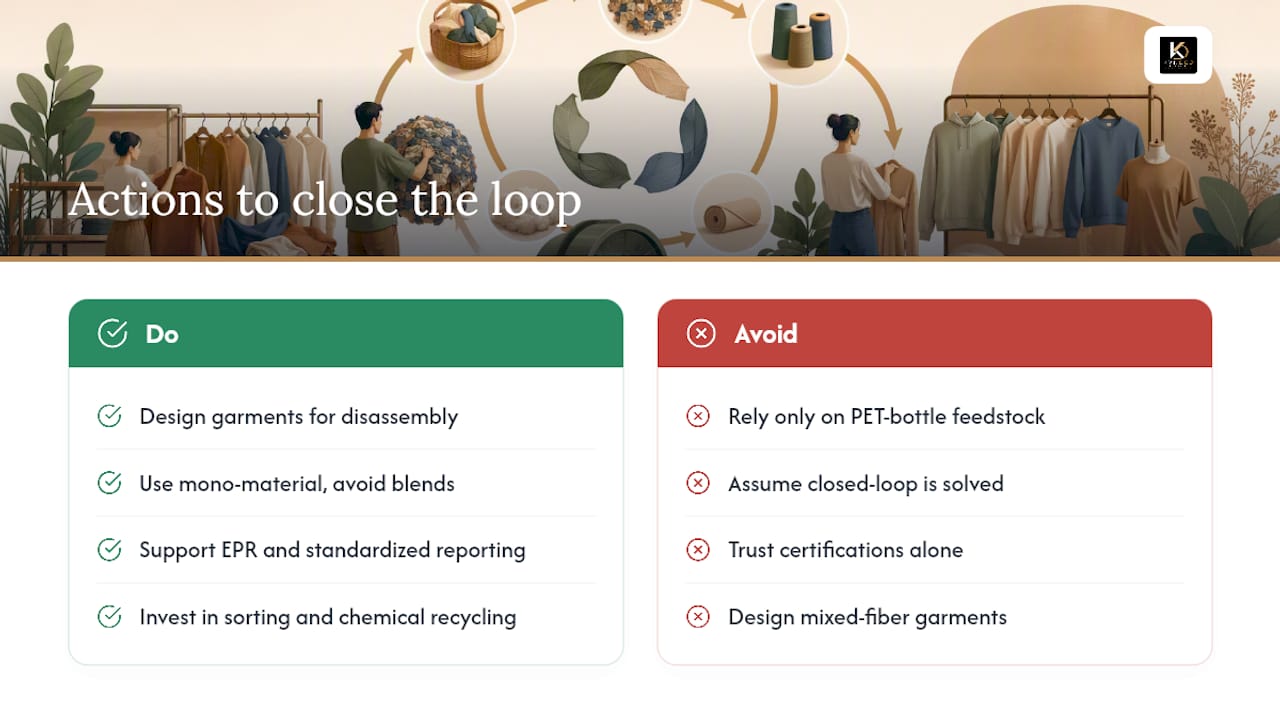
The infrastructure gap is the honest story behind the recycled-material movement. Collection rates for post-consumer textiles remain low, sorting technology struggles with blended fabrics, and contamination reduces the usable yield from collected garments. Chemical recycling is promising but still scaling. The result: most recycled fiber in clothing today comes from PET bottles, not from old garments, which means the closed-loop vision is still largely aspirational.
Policy levers that would change this include extended producer responsibility (EPR) legislation requiring brands to fund end-of-life collection, standardized recycled-content reporting, and public investment in sorting and chemical recycling infrastructure. The EU has moved further on EPR than the U.S., but domestic momentum is building through state-level textile waste legislation.
The biggest single shift the industry could make is designing garments for disassembly from the start: mono-material construction, no mixed-fiber blends, and standardized labeling that sorting machines can read. Without that, even the best recycling technology can’t close the loop efficiently.
Pro Tip: When a brand publishes a supplier list and factory audit results alongside its recycled-content claims, that transparency is a stronger signal than any single certification. Look for both.
Final verdict: are recycled materials worth it for consumers?
Yes, with conditions. Recycled materials genuinely reduce upstream energy use and emissions, and they divert waste from landfills. The LCA evidence consistently supports recycled over virgin when manufacturing energy is clean and garment lifespan is long. The condition that changes everything is use phase: a recycled garment worn twice is worse than a conventional one worn 50 times.
Purchase rule: Choose recycled-content pieces with transparent sourcing, a recognized certification (GRS or Bluesign), and a durable, versatile design you’ll actually wear for years.
Key Takeaways
Recycled materials cut clothing’s upstream impact most when paired with durable design, longer garment use, and clean manufacturing energy.
| Point | Details |
|---|---|
| Energy savings are real | RPSF uses roughly 30–50% of the energy of virgin polyester, lowering GHG at the fiber stage. |
| Use phase is the multiplier | Cradle-to-gate manufacturing is the main hotspot; more uses per garment lowers per-use impact. |
| Reuse beats recycling | Studies show clothing reuse can have up to 70 times lower environmental impact than new production. |
| Certifications to check | GRS verifies recycled content; Bluesign covers manufacturing; OEKO-TEX checks chemical safety. |
| Kyndeoactivewear’s approach | Kyndeoactivewear’s gym-to-street designs prioritize versatility and durability to extend garment lifespan. |
The case for buying less and wearing more
The recycled-material conversation in fashion tends to focus on fiber sourcing, and that’s understandable. It’s measurable, certifiable, and marketable. But the research points somewhere less convenient: the single most effective thing a consumer can do is buy fewer garments and wear each one far longer. Recycled content is a meaningful improvement at the production stage, but it doesn’t offset a fast-fashion consumption pattern.
What I find genuinely encouraging is the design shift happening at brands that build for versatility. A matching set or a well-constructed hoodie that works for a gym session, a coffee run, and a travel day isn’t just convenient. It’s a structural answer to the use-phase problem. Minimalist, multi-occasion activewear naturally extends the wear cycle without requiring the consumer to think about sustainability at all. That’s the design philosophy that makes recycled materials actually pay off.

Kyndeoactivewear’s take on durable, recycled-content activewear
Kyndeoactivewear builds gym-to-street pieces designed to move with you across every part of your day, from a morning workout to afternoon errands to a night out. That versatility is the practical answer to the use-phase problem the research keeps pointing to: pieces you reach for constantly don’t sit in a drawer losing their environmental investment.

The sustainable activewear collection reflects the principles covered here: recycled-content fabrics, durable construction, and designs built for long wear rather than a single season. Women’s matching sets and men’s leggings are built with stretch recovery that holds up wash after wash. Tees and hoodies are cut for layering across seasons, reducing the need to replace them as trends shift. Browse the full collection and find pieces built to last.
Useful sources and further reading
- Environmental sustainability of fashion product made from post-consumer waste: impact across the life cycle
- Environmental impact of textile reuse and recycling — A review
- Life cycle assessment of a circular textile value chain: the case of a garment made from chemically recycled cotton
- Sustainable Consumer Products from Recycled Textiles: Benefits, Economic Efficiency, and Environmental Influence
- Prospects and challenges of recycling and reusing post-consumer garments: A review
FAQ
What does “recycled content” on a clothing label actually mean?
It means a stated percentage of the fabric was made from recycled material, either post-consumer waste (like PET bottles or old garments) or pre-consumer industrial scraps. The Global Recycled Standard (GRS) is the most widely recognized third-party verification for this claim.
Is recycled polyester better for the environment than virgin polyester?
Generally yes. RPSF production uses roughly 30–50% of the energy of virgin polyester and generates fewer greenhouse gas emissions. The benefit is largest when the recycling facility runs on clean energy and the finished garment is worn for many years.
What certifications should I look for on recycled activewear?
Look for GRS (verifies recycled content and chain of custody), Bluesign (covers responsible manufacturing and chemical use), and OEKO-TEX Standard 100 (certifies the finished product is free of harmful substances). No single label covers everything, so two certifications together give a fuller picture.
Does Kyndeoactivewear use recycled materials in its products?
Kyndeoactivewear’s sustainable activewear line incorporates recycled-content fabrics alongside durable, versatile gym-to-street designs built to extend garment lifespan, which is where recycled materials deliver their greatest environmental return.
Is reusing old clothes better than buying new recycled-content garments?
Yes, in most scenarios. Research summarized by EuRIC found that clothing reuse can have up to 70 times lower environmental impact than new production. Buying recycled-content pieces is a better choice than virgin materials, but keeping any garment in active use as long as possible remains the highest-impact action a consumer can take.