

Activewear for group fitness is defined as performance apparel engineered to manage sweat, support movement, and hold its shape across the full range of motions a class demands. The right choice comes down to three factors: fabric performance, fit tailored to your workout type, and support matched to your intensity level. Get all three right and your gear works with you, not against you. This guide covers the fabric blends, fit principles, and capsule wardrobe strategies that keep you comfortable, covered, and confident every class.
Which fabrics work best for different group fitness activities?
Fabric is the single most important variable when you pick activewear for group fitness. The wrong material turns a 45-minute HIIT class into a sweaty, uncomfortable grind. The right one disappears on your body so you can focus on the workout.
Synthetic blends built around Nylon and Spandex are the industry standard for performance activewear. An 80–90% Nylon and 10–20% Spandex blend is the recommended ratio for hot yoga and high-sweat classes because it delivers four-way stretch and moisture-wicking in one fabric. That ratio gives you full range of motion without the fabric losing its shape after repeated washes. Polyester blends work similarly and tend to cost less, making them a solid choice for circuit training and mixed-intensity classes.
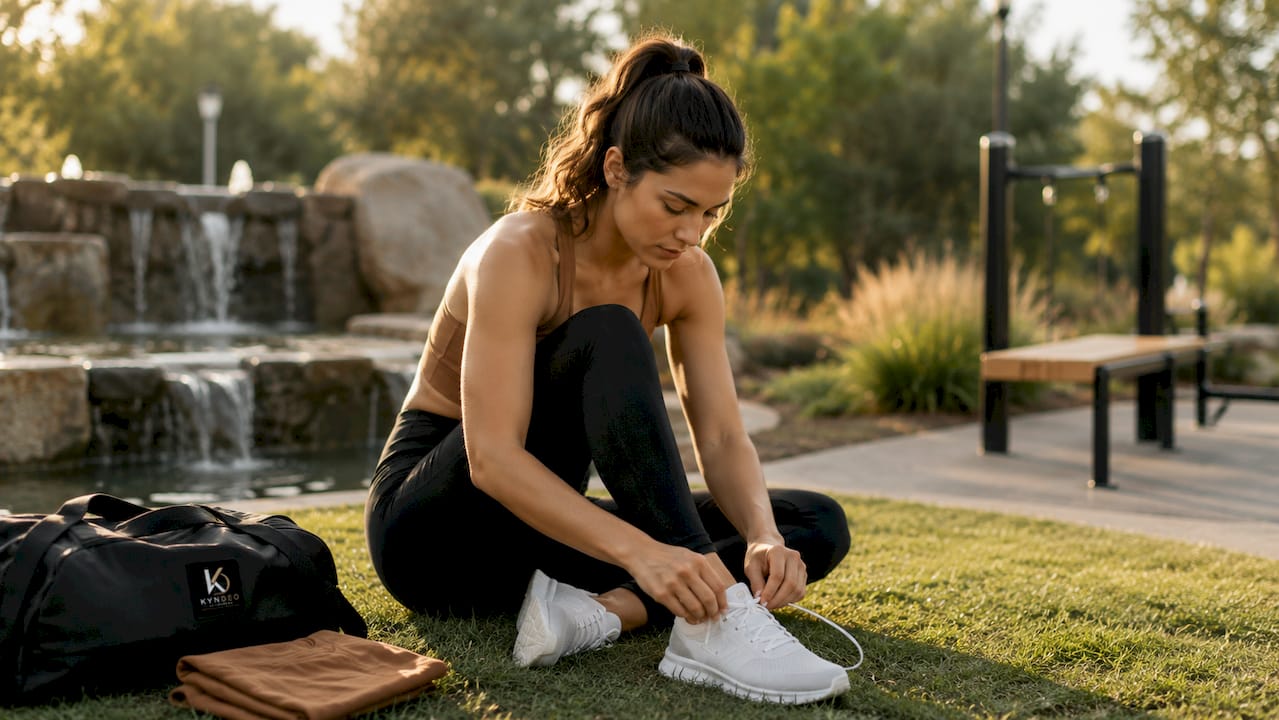
Cotton is the fabric to avoid for intense group classes. Cotton absorbs sweat, becomes heavy and abrasive against skin, and slows you down. A soaked cotton shirt in a spin class is a distraction, not a performance tool.
Key fabric properties to look for when you select activewear for hot yoga or any sweat-heavy format:
- Moisture-wicking: Pulls sweat away from skin and pushes it to the fabric surface to evaporate
- Four-way stretch: Moves with you in every direction, including floor transitions and overhead reaches
- Compression: Light compression supports muscles without restricting circulation
- Breathability: Open-knit or mesh panels release heat during high-intensity segments
- Durability: Tight knit construction resists pilling and maintains opacity after repeated wear
Pro Tip: Look for activewear with an antimicrobial finish. Technical fabrics with antimicrobial treatments reduce odor buildup across multiple intense classes, which matters when you train four or more times per week.
How to choose activewear fit and design for your workout style
Fit determines whether your gear performs or fails under real class conditions. A fabric can be technically perfect, but if the cut is wrong for your movement pattern, you will spend the class adjusting instead of training.
Loose or baggy activewear traps heat and bunches, causing discomfort and disrupting balance in classes like barre or spin. Fitted apparel, cut close to the body without being restrictive, is the standard recommendation for group formats. The goal is a second-skin feel that moves when you move and stays put when you stop.
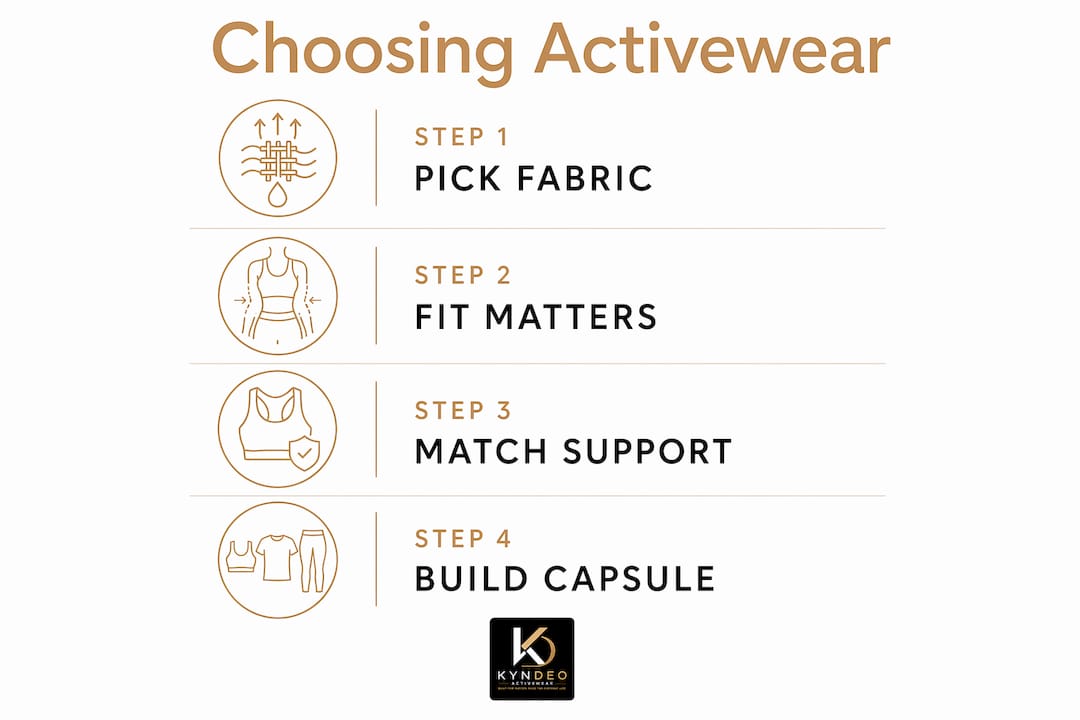
Coverage is a performance issue, not just an aesthetic one. Proper athletic design keeps leggings opaque during extreme movement and prevents tops from riding up or bunching during floor work. When you are focused on a barre sequence or a Zumba routine, gear that shifts pulls your attention away from the instructor.
Fit priorities by class type:
- Spin and cycling: Padded shorts or fitted leggings with a flat seam; avoid waistbands that dig in when seated
- Barre and yoga: High-rise leggings with a wide waistband; fitted tops that stay tucked during inversions
- Zumba and dance cardio: Flexible shorts or mid-rise leggings; tops with a relaxed but fitted cut for freedom of movement
- HIIT and circuit training: Compression shorts or leggings; moisture-wicking tanks that stay in place during burpees and jumps
High-rise leggings with a wide waistband prevent rolling during dynamic moves like squats and stretches. That stability reduces distraction and keeps your proprioception sharp during fast-paced sequences.
Pro Tip: Layer a fitted tank under a zip hoodie for early morning classes when studios run cold. You can remove the hoodie once your body temperature rises without interrupting the class.
What support levels should match your group fitness demands?
Support is the most underestimated factor when people choose workout clothes for mixed-format classes. Most people select a sports bra based on how it looks, not what the class actually requires.
Support levels break down by impact:
- Low support: Suited for yoga, Pilates, and stretching. Light compression, minimal bounce control.
- Medium support: Suited for cycling, barre, and strength training. Encapsulation or compression cups, moderate bounce control.
- High support: Suited for HIIT, running, and jump-heavy cardio. Full encapsulation, wide straps, and a firm underband.
Support level must match the highest-impact segment of your class, not just the warm-up. A circuit training class that opens with strength work and ends with plyometrics requires high support from the start. Wearing medium support because the first 10 minutes feel manageable is the most common mistake in mixed-format classes.
The same logic applies to bottoms. Leggings provide more coverage and compression than shorts, making them the better choice for floor-heavy classes like yoga or Pilates. Shorts work well for spin and cycling where ventilation matters more than coverage. For choose activewear for circuit training, compression leggings with a gusseted crotch give you the range of motion for lateral lunges and box jumps without restriction.
Pro Tip: Test every new piece before committing to it in class. Try squats, an overhead reach, and jogging in place in the fitting room or at home. If anything shifts, gaps, or digs in during those three movements, the fit is wrong for group fitness.
Shorts versus leggings is also a personal confidence call. Wearing what makes you feel strong and ready directly affects how consistently you show up. Choosing activewear for body confidence is not vanity. It is a practical training variable.
How to build a versatile activewear capsule wardrobe for group fitness
A gym capsule wardrobe is a small, intentional rotation of core pieces built around your actual training schedule. A well-built capsule includes tops, bottoms, and support pieces tuned to your workout types, the weather, and your weekly class frequency. The goal is fewer pieces that work harder, not a full drawer of items you rarely wear.
Start by identifying your two or three primary class formats. If you do spin twice a week and HIIT twice a week, your capsule needs to serve both. Build from there.
A functional starting capsule for four training days per week:
| Piece | Recommended count | Best for |
|---|---|---|
| High-rise leggings | 3 | Yoga, barre, HIIT, mixed classes |
| Compression shorts | 2 | Spin, circuit training, warm weather |
| Fitted tanks | 4 | All class types, layering base |
| Sports bras (high support) | 3 | HIIT, jump cardio, mixed intensity |
| Sports bras (medium support) | 2 | Strength, barre, cycling |
| Zip hoodie or lightweight layer | 1 | Warm-up, cool-down, cold studios |
Activewear wardrobes built around your primary training type deliver more comfort and performance than fashion-first selections. The practical move is to identify the weakest item in your current rotation, the piece causing the most discomfort or distraction, and replace it first.
Track what you actually wear. If two leggings sit unused after a month, they are not serving your training. Rotate them out and replace with pieces that match your real schedule. Kyndeoactivewear organizes its collections by activity type and gender, which makes building a purposeful capsule faster than browsing a generic catalog.
A few principles that keep a capsule working year-round:
- Replace sports bras and waistbands first. They lose elasticity faster than any other piece.
- Choose neutral base colors so every top pairs with every bottom.
- Add one printed or coordinated set for motivation. Wearing something you like increases the likelihood you show up.
Key Takeaways
The most effective approach to picking activewear for group fitness is to match fabric performance, fit, and support level to your specific class format before considering style.
| Point | Details |
|---|---|
| Fabric first | Choose 80–90% Nylon and 10–20% Spandex blends for moisture-wicking and four-way stretch. |
| Fit for your format | Fitted, not baggy, apparel prevents bunching and maintains coverage during dynamic movement. |
| Match support to intensity | Select support level based on the highest-impact segment of your class, not the warm-up. |
| Test before class | Perform squats, an overhead reach, and jogging in place to confirm fit before wearing gear in a group setting. |
| Build a capsule | A small rotation of 3 leggings, 4 tanks, and 5 sports bras covers most four-day training schedules. |
What I’ve learned about style versus function in group fitness gear
People consistently underestimate how much their gear affects their training consistency. I have seen it repeatedly. Someone buys a beautiful set in a cotton blend, wears it to one HIIT class, and never reaches for it again because the experience was miserable. The gear gets blamed for the discomfort, but the real issue was the fabric choice.
The good news is that the gap between technical performance and great style has closed significantly. Technical fabrics have evolved to the point where you no longer have to choose between a piece that performs and a piece that looks intentional. The best activewear today does both without compromise.
My honest advice: prioritize fabric and support first, then let style be the tiebreaker. When two pieces meet your performance requirements, pick the one that makes you feel ready. Confidence in your gear is a real training variable. Showing up consistently matters more than any single workout, and wearing something you feel good in makes showing up easier.
Kyndeoactivewear builds its collections around exactly this principle. The pieces are movement-ready and stretch-fitted, but they are also designed to look coordinated from the studio to the street. That combination is not a marketing angle. It is what the modern group fitness participant actually needs.
— Bryan
Kyndeoactivewear collections built for group fitness
Group fitness demands gear that holds up across formats, from hot yoga to circuit training to spin. Kyndeoactivewear offers women’s activewear collections and men’s activewear collections built around technical fabrics, high-rise fits, and coordinated sets designed for real training days.
The matching sets make capsule wardrobe building straightforward. Every piece is designed to pair with others in the collection, so you spend less time planning outfits and more time focused on your class. Whether you need high-rise leggings for barre, compression shorts for spin, or a full coordinated set for mixed-intensity training, Kyndeoactivewear’s catalog is organized by activity type so you find the right piece fast.
FAQ
What fabric is best for group fitness classes?
An 80–90% Nylon and 10–20% Spandex blend is the industry-recommended fabric for group fitness because it delivers four-way stretch and moisture-wicking performance. Avoid cotton, which absorbs sweat and becomes heavy during intense classes.
How do I choose the right sports bra for mixed-format classes?
Choose support based on the highest-impact activity in your class, not the lowest. A class that combines strength training with plyometrics requires high-support gear from start to finish.
Should I wear leggings or shorts for circuit training?
Compression leggings with a gusseted crotch are the better choice for circuit training because they provide coverage and range of motion for lateral movements and floor transitions. Shorts work well when ventilation is the priority.
How many activewear pieces do I need for a four-day training week?
A functional capsule for four training days includes 3 leggings, 2 compression shorts, 4 tanks, 3 high-support sports bras, and 2 medium-support sports bras. That rotation covers washing cycles without leaving you short before class.
How do I know if activewear fits correctly for group fitness?
Test each piece with three movements: a squat, an overhead reach, and jogging in place. If anything shifts, gaps, or digs in during those movements, the fit will cause problems in class.