

Abrasion resistance determines whether your leggings, tees, and joggers keep their look, fit, and skin comfort through hard workouts and everyday use. It is the single most underrated factor in activewear buying decisions, and it shows up fast once training friction enters the picture.
- Preserves appearance: resists pilling, surface fuzzing, and fabric thinning at high-friction zones
- Maintains fit and compression: fabrics that hold their structure under repeated stress keep their stretch recovery session after session
- Prevents chafing: a worn, roughened surface turns against your skin; intact fabric stays smooth and comfortable
Standard tests like Martindale (ASTM D4966 / ISO 12947) put a number on this property. Fumao Fabric recommends 15,000 Martindale cycles as a practical minimum for activewear, with higher cycle counts marking premium durability. Kyndeoactivewear builds its gym-to-street pieces with that performance bar in mind.
Key Takeaways
Abrasion resistance is the core durability factor in activewear: fabrics engineered with nylon-forward blends, compact-spun yarns, and stable knit structures outlast soft-finish alternatives in training and daily wear.
| Point | Details |
|---|---|
| Martindale cycles matter | Look for a practical minimum cycle count; higher thresholds signal premium durability for activewear. |
| Nylon beats polyester for friction | Nylon-dominant blends test better on Martindale for high-abrasion uses like leggings and lifting shorts. |
| Lab scores need context | A high abrasion score only holds in real wear when fiber, yarn, knit, and finish are all aligned. |
| Care extends performance | Wash cool, turn inside out, skip fabric softener, and air-dry to preserve compression and surface integrity. |
| Kyndeoactivewear builds for this | Kyndeoactivewear’s gym-to-street pieces use nylon-forward blends and reinforced construction for lasting performance. |
Table of Contents
- Why does abrasion resistance matter for training performance and style?
- How are abrasion resistance tests measured, and do lab scores predict real-world wear?
- Which materials and constructions actually hold up for gym-to-street wear?
- What should you check on a product page before buying?
- How do you care for abrasion-resistant activewear so it stays that way?
- When should abrasion resistance not be your only priority?
- How Kyndeoactivewear designs pieces built to last from gym to street
- The real reason abrasion resistance shapes every buying decision
- Durable gym-to-street pieces, ready to shop at Kyndeoactivewear
- Sources
- FAQ
Why does abrasion resistance matter for training performance and style?
Training creates friction. Every squat, lunge, and deadlift puts your leggings through inner-thigh contact. Every bench press session drags shorts across a vinyl pad. Barbell knurling catches sleeve fabric on tees and hoodies. These training surfaces are the primary driver of pilling and surface wear, not the washing machine.
High-friction zones by garment type:
- Leggings: inner thigh, back of knee, waistband edge
- Shorts: seat and inner thigh against benches or saddles
- Sports bras: strap edges, underband, and side panels against arms
- Tees and hoodies: collar, cuffs, and sleeve underarm seam
When abrasion resistance is low, the surface degrades in a predictable sequence. Here is what to watch for:
| Sign of wear | Where it appears | What it means |
|---|---|---|
| Pilling | Inner thigh, seat, underarm | Fiber ends breaking free and tangling |
| Surface fuzzing | Any high-contact zone | Early-stage pilling before pills form |
| Fabric thinning | Inner thigh, seat | Structural fiber loss; compression drops |
| Color/sheen loss | Broad surface areas | Fiber surface damage scattering light |
| Seam wear | Crotch, underarm, waistband | Thread abrasion from movement and stretch |
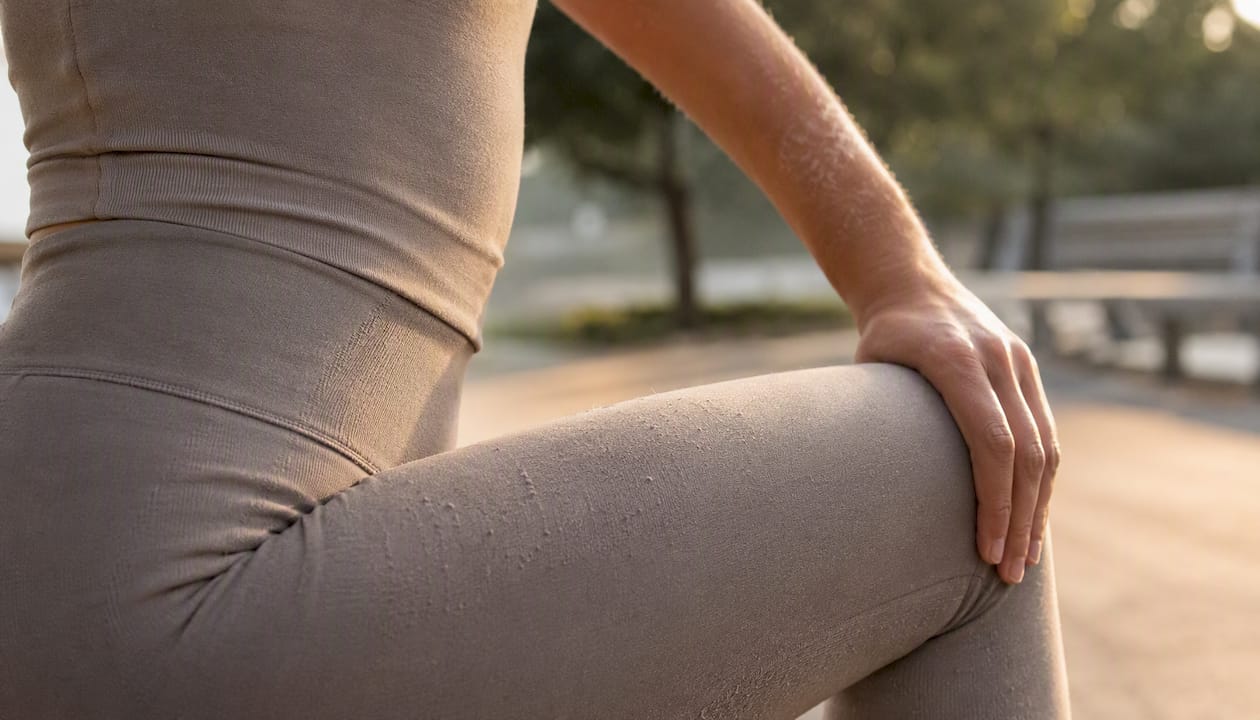
Once pills form, the surface becomes abrasive against skin. That is when a comfort problem becomes a performance problem.
How are abrasion resistance tests measured, and do lab scores predict real-world wear?
Two tests dominate activewear quality control. Martindale (ASTM D4966 / ISO 12947) moves a fabric sample in a figure-eight pattern against a standard abradant and counts cycles to visible damage. Wyzenbeek (ASTM D4157) runs fabric back and forth against cotton duck or wire mesh. Both produce a cycle count, but they measure different friction patterns, so scores are not directly comparable across the two methods.
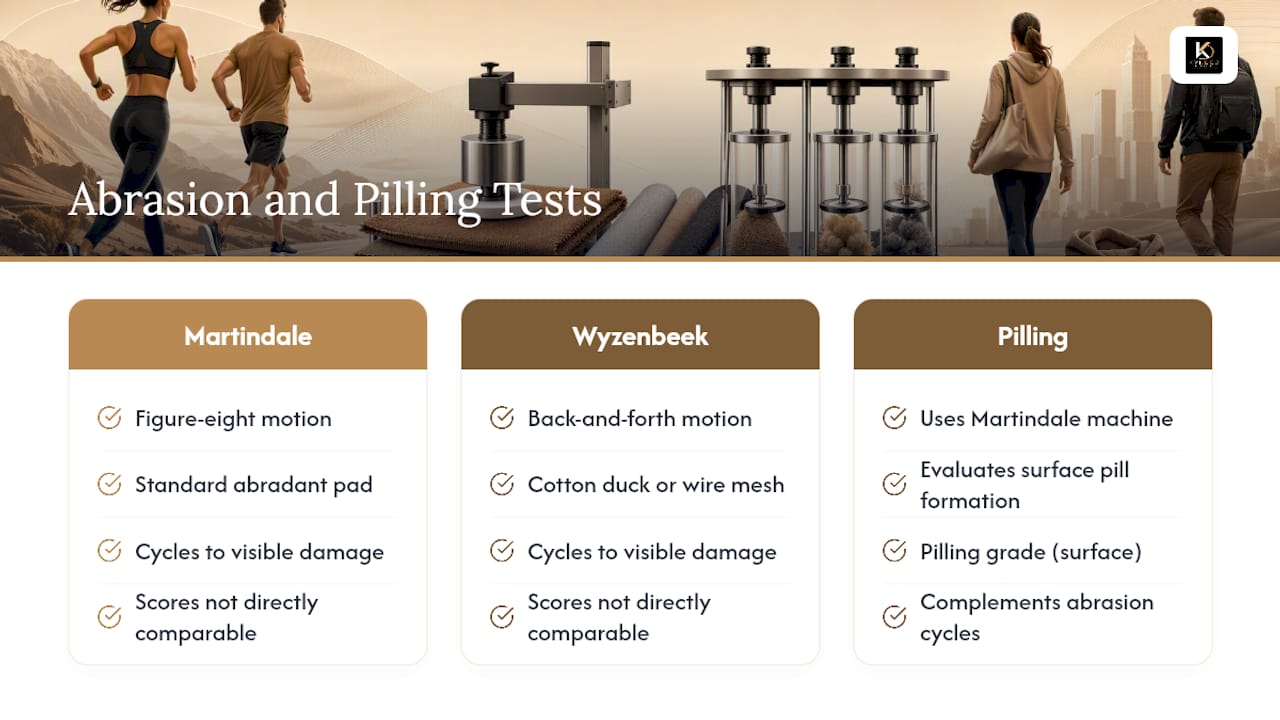
Pilling is a separate metric. ISO 12945-2 uses the Martindale machine but evaluates surface pill formation rather than structural breakdown. A garment can score well on abrasion cycles and still pill heavily if the fiber blend is wrong. Both numbers matter.
Here is the critical caveat: Testex experts warn that a high lab score does not guarantee real-world longevity unless the full fabric system, meaning fiber, yarn structure, knit construction, and finish, is properly aligned. A brand that applies an anti-pilling finish over a weak fiber blend can pass a lab test and still degrade quickly in daily training.
Pro Tip: When reviewing product tech specs, ask for both the Martindale abrasion cycle count and the pilling grade. One number without the other tells only half the story.
Which materials and constructions actually hold up for gym-to-street wear?
Fiber choice is the foundation. Nylon-rich blends test better on Martindale than polyester-rich blends for high-abrasion applications like lifting shorts and leggings. Nylon fiber is inherently tougher and more abrasion-resistant at the filament level. Polyester microfilaments offer good moisture management but wear faster under repeated friction. Cotton and brushed finishes feel soft initially, yet brushed surfaces increase pilling risk because the raised fibers catch and tangle more easily.
For four-way stretch, the elastane content typically ranges in the single-digit to mid-teens percentage with supportive knit construction. Below that range, stretch recovery weakens. Above it, heat sensitivity rises and elastic fatigue can accelerate.
Construction matters as much as fiber. Double-knit and interlock structures lock yarns in place, reducing the loose loops that abrade and pill. Compact-spun yarns have fewer protruding fiber ends, so there is less raw material for pills to form from. Long floats in a knit face, common in some fashion-forward fabrics, create exposed yarn that snags easily.
Use-case matching:
- Heavy lifting: prioritize nylon–spandex double-knit; abrasion resistance outweighs softness
- Studio yoga or Pilates: polyester–spandex with a smooth face works well; friction is lower
- All-day street wear: compact-spun nylon blends balance durability with a cleaner drape
Comfortable fabrics for daily wear that hold up through movement share one trait: the fiber engineering comes first, and the finish is secondary.
What should you check on a product page before buying?
Tech specs predict durability better than marketing language. “Anti-pilling” on a hang tag means nothing without the numbers behind it. Close-up product photography and transparent specs are stronger purchase signals than any marketing claim.
Buying checklist:
- Fabric composition listed as a percentage (look for nylon or nylon-dominant blends)
- Denier or GSM when shown (higher denier = denser, more abrasion-resistant fabric)
- Mention of double-knit, interlock, or compact-spun construction
- Martindale cycle count and pilling grade in the product tech info
- Close-up photos of inner-thigh panels, seat, and waistband
- Customer reviews that mention pilling, sagging, or thinning after repeated use
- Warranty or wear guarantee language from the brand
Pro Tip: If a product page lists only fiber percentages but no construction details or test numbers, check the brand’s educational content. Brands that invest in fabric engineering usually explain it.
How do you care for abrasion-resistant activewear so it stays that way?
Proper care preserves abrasion performance, but it cannot fix a poor fabric choice. That distinction matters practically: consumers often blame laundering for degradation that training friction caused.
Core care practices:
Wash cool (30°C / 86°F or below) and turn garments inside out before washing. This protects the outer face, which is the surface that contacts skin and shows wear. Skip fabric softener entirely. It coats fibers and reduces moisture-wicking performance while softening the surface in ways that increase pilling over time.
Air-dry whenever possible. Repeated high-heat drying accelerates elastic fatigue and fit loss, especially in elastane-heavy pieces. If you use a dryer, low heat only. Separate activewear from rough items like denim, zip-up hoodies, and towels, which act as abradants in the drum.
For localized pilling, a fabric shaver removes surface pills without damaging the base fabric. Thin spots at the inner thigh or seat are structural, not cosmetic. Once the base fabric thins, compression is gone and the garment is ready to retire or recycle.
When should abrasion resistance not be your only priority?
Durability is not the only variable. Every fabric choice involves trade-offs, and the right balance depends on how and where you wear the piece.
- Brushed soft finishes feel luxurious but pill faster; reserve them for low-friction uses like casual wear or light studio sessions
- Higher denier adds toughness but reduces drape; a structured lifting tight looks different on the street than a lightweight jogger
- Higher elastane percentage improves compression but raises heat sensitivity; overheating in dryers speeds elastic fatigue
- Fit extremes accelerate wear: a too-tight fit increases friction at every contact point; a too-loose fit creates fabric bunching that abrades at folds
For studio yoga, a softer polyester-spandex blend is a reasonable trade-off. For high-volume lifting five days a week, nylon-dominant construction is the right call. All-day street wear sits in the middle: you want durability without sacrificing the drape that makes a set look intentional off the gym floor.
How Kyndeoactivewear designs pieces built to last from gym to street
Kyndeoactivewear builds its collections around the gym-to-street reality: pieces that move through a workout and then keep looking sharp for the rest of the day. That means fabric engineering comes before styling decisions.
What to look for across Kyndeoactivewear product pages:
- Fabric composition listed by percentage, with nylon-forward blends in high-friction pieces like men’s leggings and men’s joggers
- Reinforced construction at inner-thigh panels, waistbands, and seam junctions
- Four-way stretch with elastane in the 8–15% range for compression that recovers
Educational resources from Kyndeoactivewear:
- Why Activewear Outlasts Fast Fashion: Durability Explained on the KYNDEO Journal covers fabric engineering and longevity in plain language
- The sustainable activewear page explains how construction choices connect to longer garment life
- Product category pages for women’s activewear and men’s activewear organize pieces by activity type, making it easier to match construction to use case
The real reason abrasion resistance shapes every buying decision
Most shoppers focus on color, cut, and price. The fabric system underneath those choices is what actually determines whether a piece lasts six months or two years. Kyndeoactivewear invests in nylon-forward blends and stable knit constructions because the brand’s customers wear these pieces hard: gym sessions, errands, travel, and everything in between. A garment that pills after three weeks of inner-thigh friction is not a gym-to-street piece. It is a gym piece that retired early.
The transparency argument is simple. When a brand lists fiber percentages, construction details, and test data, it is showing its work. When a brand leads with “anti-pilling” as a marketing claim and nothing else, it is asking you to trust the finish rather than the engineering. Fabric engineering built on fiber selection, compact-spun yarns, and stable knit structures is what Testex calls the right pathway, and it is what separates pieces that hold up from pieces that look good on the rack.
Durable gym-to-street pieces, ready to shop at Kyndeoactivewear
If the buying checklist above describes what you have been looking for, Kyndeoactivewear’s gym-to-street collection is the direct answer. The brand curates pieces by activity type and gender, so you can match construction to use case without guessing. Matching activewear sets are built for coordinated looks that hold up through training and carry into the day. Browse women’s activewear or men’s activewear to find pieces with the fiber specs and construction details this guide recommends. Check the product pages for fabric composition and reach out to the team with questions about specific tech specs.
Sources
- The Truth About Pilling | From Mechanisms and Spinning Methods to Standards—How Fabrics Can Truly Be “Pill-Free” - Testex
- What Are the Key Quality Parameters for Performance Activewear Fabrics? – Fumao Fabric
- Best Anti-Pilling Fabrics: Top 6 Picks AND 4-Step Guide - JaceApparel
- Performance Fabric in Strength Training: Polyester, Lycra, Nylon, and – CURATED SENSE
- Why Activewear Pills or Loses Compression
FAQ
What is a good Martindale score for activewear leggings?
Fumao Fabric recommends a minimum Martindale cycle count for activewear, with higher cycle values indicating premium durability suitable for high-friction training.
Why do my leggings pill at the inner thigh even after careful washing?
Inner-thigh pilling is driven by training friction, not laundering. Contact with benches, mats, and body movement is the primary cause; washing care helps but cannot compensate for a fiber blend that lacks abrasion resistance.
Does a higher spandex percentage make activewear more durable?
Not necessarily. Higher elastane improves compression and stretch recovery, but overheating in dryers and overstretching accelerate elastic fatigue.
How does Kyndeoactivewear approach fabric durability?
Kyndeoactivewear builds gym-to-street pieces using nylon-forward blends and reinforced construction at high-friction zones, with product pages listing fiber percentages and construction details so shoppers can verify specs before buying.
Can fabric softener damage activewear over time?
Yes. Fabric softener coats fibers, reducing moisture-wicking performance and softening the surface in ways that increase pilling susceptibility. Skip it entirely and air-dry instead to preserve both compression and surface integrity.